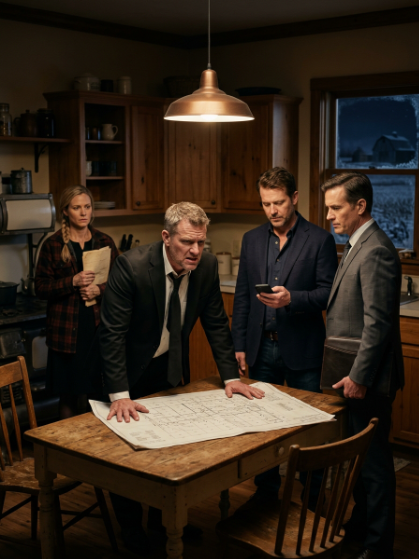
Bjorn’s pen stopped, and for a moment the only sound in the kitchen was the old furnace ticking down in the basement.
“What field?” Anders said. “What are you even talking about?”
I unfolded the deed all the way and smoothed it flat right on top of their pretty map.
“The back forty. The strip along the creek. Eleven years ago, when the Hansens sold off their corner, the two of you were in Chicago and Denver and couldn’t be bothered to call Dad back about it. So I took out a loan against my truck and emptied my savings, and I bought it. In my name. Because Dad and I both knew that someday, somebody would try to sell this place out from under itself — and that field is the only way a buyer ever reaches the highway.”
Connor Webb, the developer, leaned over the map. I watched him find the creek with one finger. Watched him trace the only road in. Watched him understand it before my brothers did.
“The access easement runs through her parcel,” he said slowly, straightening up. “There’s no other route. The grade’s too steep on the north line, and that’s protected wetland on the south.” He tapped his leather folder shut. “Gentlemen. Without that field, there is nothing I can do here. The rest of it is landlocked.”
“So buy the field from her,” Bjorn snapped. “Whatever she paid, offer her double.”
Webb looked at me, eyebrows up, waiting.
“It is not for sale,” I said. “And neither is the water that runs under it.”
Webb was a businessman, not a fool. He left his card on the counter out of pure habit, told my brothers to call him if “circumstances changed,” and drove back to wherever men like him sleep at night.
My brothers turned on me then, both at once, the exact way they did when we were kids and I had wrecked one of their schemes.
“You’ve been sitting on this for eleven years?” Anders said. “You let us drive all the way out here thinking—”
“I let you think nothing,” I said. “You never once asked. You called twice a year. You sent a wreath to the funeral home and decided that made you landowners. I drove him to chemo in Des Moines forty times. I can tell you the name of every nurse on that floor, and which one made him laugh.”
Bjorn played his last card, the one I had known was coming. “The will splits the home parcel three ways. Evenly. You can’t keep us out forever, Sarah.”
“You’re right,” I said. “It does split evenly. I never said otherwise.”
Then I set the second envelope on the table, beside the deed.
“Dad’s lawyer gave me this to open after the funeral. It’s a letter — and a first right of refusal that Dad wrote into the estate himself. If the home parcel is ever sold, I have the right to buy out your shares first. At the appraised farm value. Not Webb’s inflated developer number. Farm value.”
I had the land appraised the week Dad went into hospice. He’d asked me to, in that quiet voice he had near the end.
“He knew,” I said. “He knew which of his children would try to carve him up before the casseroles got cold. So he made sure the one who stayed could keep the place whole.”
Bjorn read the letter once. Then again. Anders read it over his shoulder. Whatever the two of them had driven all this way believing, it drained right out of them at that table, in that kitchen, under that low yellow lamp.
In the end they took the buyout. Farm value, fair and legal and witnessed — more than they had ever earned from this land, and a great deal less than they had let themselves dream about on the drive over. They signed in the same kitchen where we had eaten ten thousand breakfasts as kids, and then they got in their rental car and drove back toward their airports, and I don’t hear from either of them much anymore.
That part is its own kind of grief. I won’t stand here and pretend it isn’t.
But the land is whole. The creek still runs through the back forty, and the back forty is still in my name. The combine still starts on the third try, exactly the way Dad always swore it would if you were just patient with it.
Last week I planted the windbreak he had been meaning to put in for years — a long row of young oak saplings down the edge of the very road the developer wanted to pave over.
They’ll take thirty years to amount to much of anything.
I planted them anyway.
That is the whole difference, I think, between the ones who stay and the ones who sell.