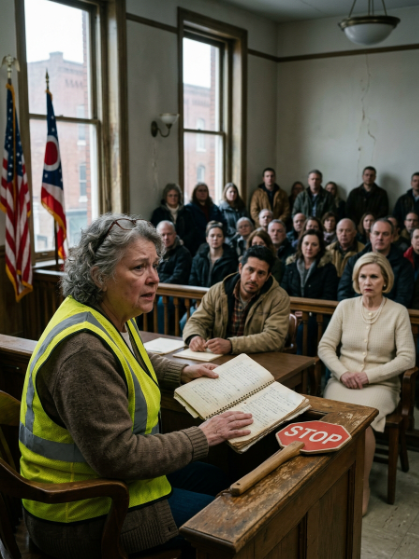
Ada Mercer licked her thumb and turned to the first page like she was reading off a recipe.
“I started this the year they put the new light in at Third and Vine,” she said. “Habit of mine. I like to know whose children are whose, in case one ever wanders. So every morning I write down who brings them and who takes them.”
The judge, to his credit, let her talk.
“These two,” she said. “Lily and Sam Reyes. I’ve walked them across that corner since Lily was in pull-ups.”
She read.
She read dates. She read the weather. She read, in her small careful hand, who stood on that corner at 7:50 every morning and who was there at 3:15 every afternoon.
For two years, the name in the notebook was almost never a Faulkner.
It was a rotating cast of paid sitters. A neighbor. Once, memorably, a rideshare driver Margaret had hired because no one in that big house wanted to get up early.
“And the father?” the judge asked.
Ada looked at me. Something in her face was so kind I had to stare at the flag behind the bench so I wouldn’t come apart in front of the whole town.
“Birthdays,” she said. “The Christmas concert, two years running. The day Sam broke his wrist on the monkey bars — that man drove through the night and was standing on my corner by morning, white as a sheet, holding a juice box he’d bought at the gas station because Sam likes the apple kind.” She tapped the page. “I wrote it down. I write everything down.”
Then she said the thing that turned the room.
“Children don’t run to the people who keep them,” Ada said. “They run to the people who love them. Every time that man’s truck came down Front Street, I watched two kids drop their backpacks and run. I’ve stood on that corner twenty years. You learn the difference.”
The Faulkners’ attorney objected to something. The judge overruled it without looking up.
Because here is what Ada’s notebook did that my bank statements could not.
My lawyer had records of every dollar I sent. The Faulkners had simply called it “guilt money” from a man who was never around. Paper against paper.
But Ada’s notebook was a witness. Twenty years of credibility in a yellow vest. And her dates lined up with my pay stubs, my gas receipts, my phone records — every birthday I drove eleven hours for, every weekend the Faulkners had told the court I “couldn’t be bothered” with.
They had not counted on her. Nobody ever counts on the crossing guard.
By the time her testimony was finished, the story the Faulkners had spent three years building in this town had a hole in it you could drive a pipeline truck through.
Margaret took the stand again to “clarify.” It went badly. Under oath, asked directly whether she had ever told the children their father didn’t want to see them, she hesitated a half-second too long.
The judge saw it. Everyone saw it.
The ruling came the following week. Primary custody to me. A schedule that put Lily and Sam in my truck and in my house and in my life full-time, with their grandparents granted visitation — which is more grace than they showed me, but my kids love them, and I won’t be the one who teaches them otherwise.
I rented a place on the good side of the river, close to the school.
Close to Ada’s corner.
The town that had decided who I was took a while to catch up. Some folks still won’t meet my eye at the diner. That’s all right. I didn’t come back for them.
But Mrs. Calloway, who runs the register, started slipping the kids a free cookie. The pastor who had believed Margaret’s version stopped me in the lot and said, simply, “I got it wrong, Daniel. I’m sorry.” It costs a man something to say that. I shook his hand.
I bring Ada a coffee most mornings now. Cream, two sugars. She still has the vest, still has the STOP sign, still has the notebook, though she says she is training the young fellow who’ll take over when her knees finally quit.
“You didn’t have to do that,” I told her once. “Put yourself in the middle of it.”
She held up that little spiral notebook and smiled.
“Son,” she said, “I wasn’t in the middle of anything. I just write down who shows up.”
So do I, now. Every birthday. Every concert. Every apple juice box.
I write it down by being there.