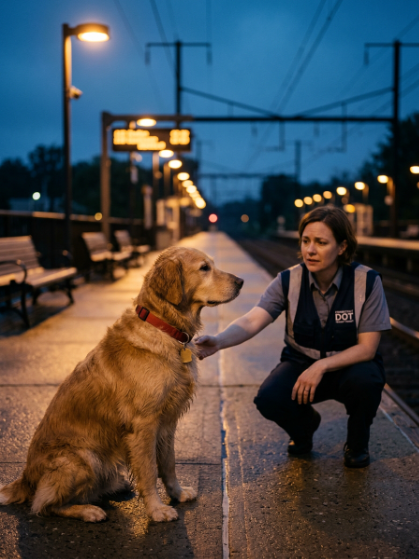
The nurse let me sit with the file for a minute, the way you let someone sit with bad news before you ask them to sign for it.
Arthur Penn. Seventy-four. Brought in on a Tuesday in February after collapsing on the platform during the evening rush. No emergency contact anyone could reach. He died two days later without a single visitor in the room.
“His belongings are still in the property office,” she said. “Nobody ever came. After a while, we stop calling the numbers.”
I took the box home.
A wallet worn to the shape of his hip. Reading glasses with one arm taped. A monthly train pass. And a small brass key — the kind that fits the old coin lockers at the far end of the station, the ones almost nobody uses anymore.
The next morning I opened locker 112 at Glenbrook, the one I had walked past ten thousand times without a single thought.
Inside was a shoebox. Inside the shoebox were letters — dozens of them, each one addressed, stamped, and never mailed. Every single one to the same person.
Katherine Penn. An address in Portland, Oregon. His daughter.
I read the one on top right there on the platform, in the gray morning light, with Biscuit pressed warm against my leg — because of course he had followed me there, the way he followed anything that smelled like hope.
The letter said he was sorry. That he knew he had turned hard and bitter after her mother died. That he had said something at the funeral he could never take back — words about her mother’s will, about money, that came out of grief and landed like a slap. That pride had eaten eleven years he would give anything to have back.
It said he rode the 6:14 home every night, past the exit for the airport, and thought about flying out to her, and never once found the nerve to stay on the train past his own stop.
The last letter in the box was dated the week before he collapsed. The handwriting was shakier than all the rest.
It said: I bought the ticket. I leave March 14th. I’m finally coming to see you, and I’m bringing the dog, because you always said a house isn’t a home without one. I’m sorry it took me so long to be brave.
He never made the flight. He collapsed on the platform four days before it.
It took me three weeks to find Katherine. A search engine, an old phone book, two wrong numbers, and then, on a Sunday evening, the right one.
When I told her, she was quiet for so long I thought the call had dropped.
“He was coming?” she finally said, her voice gone very small. “He actually bought a ticket?”
“For March,” I said. “He was bringing the dog.”
She flew out the following week.
She stood on Platform 4 at 6:14 in the evening — the exact place and the exact minute her father had waited every night of his last lonely year — and Biscuit walked up to her slow. He sniffed her offered hand. Then he leaned his entire weight against her shins, the way dogs do when they have decided something for good.
“He smells like Dad’s coat,” she whispered, and went down to her knees on the wet concrete, and held him while the train she did not need pulled in, and pulled out, and left the two of them there together.
She read every letter that night. All of them, in order, in the little station café, until the lights went down — eleven years of a proud man trying to fold an apology small enough to fit inside an envelope he was too afraid to mail.
“I was angry for so long,” she told me, “that I forgot I had also just been waiting. The whole time. Same as him. Same as the dog.”
She took Biscuit home to Portland.
She sends me a photo every so often — a golden retriever on a wide front porch in the rain, in a house that is finally a home, lying by the door like he is still half-listening for a train to come in.
I think about Arthur more than I expected to. About the eleven silent years. About the ticket he finally bought. And about the eight blocks his dog walked, alone, to a hospital, to sit at a set of automatic doors and wait for a man who was never going to come back through them.
Love does not always arrive in time. Arthur’s didn’t.
But it kept showing up at the platform every single evening, on four patient legs, until somebody finally followed it home.