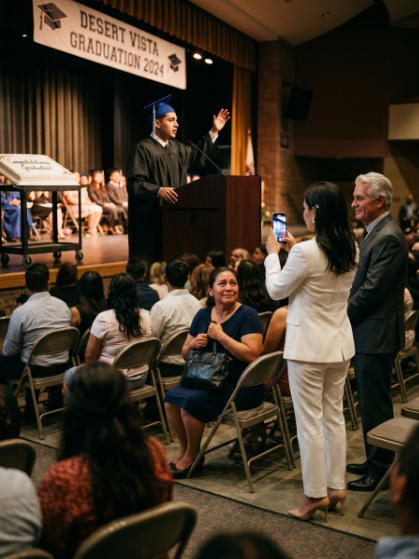
Diego’s voice didn’t shake. That is the thing I will remember. Mine would have. His didn’t.
“Most of you know me as the kid who was always at the salon after school,” he said. “Doing homework in the chair while my aunt cut hair until her hands cramped. What you don’t know is that she wasn’t babysitting. She was raising me. There’s a difference, and tonight everybody is going to learn it.”
I wanted to disappear into the folding chair. I wanted to stand up and tell him to sit down, win the scholarship, be polite, don’t make trouble. Nineteen years of swallowing it had trained my body to swallow it.
But he wasn’t asking permission.
“When I was four months old, my mother decided she had things to figure out,” Diego said. “My aunt Mari was twenty-eight. She gave up everything that was supposed to be hers, and she took me. She worked two jobs my entire life. I never knew we were poor until I was old enough to do the math, because she never once let me feel it.”
Yolanda’s phone was still up, still filming. Slowly, it lowered.
“She came to every game. Every concert. Every parent night, with the same purse, in the front row.” He found me in the third row. “She’s not in front tonight because she didn’t want to make it about her. She never does.”
Half the auditorium was crying. The other half was looking at the woman in the white pantsuit frozen in the aisle.
“So when somebody shows up tonight in a brand-new outfit, calling herself my mom and calling the woman who raised me a babysitter,” Diego said, “I think this room deserves to know why she’s really here.”
This was the part I did not know was coming. The part that still makes my chest hurt.
“Three weeks ago I signed with a university on a full engineering scholarship,” he said. “There’s a stipend. And because of some research work, a signing bonus from a sponsor. It made the local paper. My biological mother hadn’t called in six years.” He paused. “She called the day after that article ran. To talk about ‘reconnecting.’ About being ‘a family again.’ And eventually, about money.”
A sound went through the crowd like a wave hitting rocks.
“I’m not telling you this to be cruel,” Diego said, and now, finally, his voice caught, just once. “I’m telling you because my aunt never would. She’d let this whole town keep thinking she was the help. And I’m done letting people think that.”
He looked toward the side of the stage. “Dr. Okonkwo, before I accept anything tonight, there’s one more thing.”
He pulled a folded paper from inside his gown — not the speech. A legal form.
“I filed to take her name,” he said. “Officially. I’m not Diego Vega because of who left. I’m Diego Vega because of who stayed. Same name. New reason.”
Then he looked at me, and said the only words I will need for the rest of my life:
“Tia. Stand up. Let them see my mom.”
I don’t remember standing. I remember the sound — an entire auditorium rising to its feet for a hairdresser in a navy dress with a worn black purse, while my sister gathered her silver-haired man and what was left of her dignity and slipped out the side door, past the tall white cake nobody would ever cut.
The cake said REAL MOM in blue icing. The custodian wheeled it away during the applause like it was evidence. In a way, it was.
Yolanda called me twice after that night. The first time, angry. The second time, quieter, fishing to learn whether Diego “really meant” the part about the name. I told her he did, and that if she wanted a relationship with her son, it would have to begin with an apology and a long road — not a cake and a camera.
She hasn’t called since. I won’t pretend that doesn’t ache somewhere. She is still my sister. But Diego is my son, and I have learned the hard way that love is just showing up, over and over, on the ordinary days nobody films.
Diego starts engineering school in the fall. He drives a used car I co-signed. He still does his reading at the kitchen table while I cook, out of pure habit, the two of us in comfortable quiet.
Some nights he catches me watching him and rolls his eyes. “I’m fine, Tia.”
“I know,” I say.
I cut hair for nineteen years. I did not do it so that one day a packed auditorium would rise to its feet for me.
But I would be lying if I said it didn’t heal something I had long since stopped admitting was broken.