We drove to the shelter for a puppy. We came home with a dog who was scheduled to be put down that Friday.
His name was Gus. Thirteen years old. Gray muzzle, one cloudy eye, an ear torn long before we met him. While the young dogs threw themselves at the wire, Gus just walked to the front of his kennel, pressed his nose against it, and looked at my kids like he’d been waiting for them.
The card on his cage said “owner deceased.” The volunteer lowered her voice and told me the rest: an old man named Walter had brought Gus in after a stroke landed him in care. Nobody adopts the old ones, she said. Gus had until the end of the week.
My daughter Lily was eight. She slid two fingers through the chain-link, and Gus rested his chin against them like it was the most natural thing in the world.
“Mom,” she said. “He doesn’t want to be alone.”
My son Sam, ten, was already reading the adoption leaflet out loud, voice cracking on the word “senior.”
The vet was honest. Gus’s heart was weak. Maybe a year. Probably less. My husband Greg looked at me over the kids’ heads, and we didn’t even need to say it.
We took the old man home.
What that dog did with the months he had left, I will never be able to repay.
He learned the school bus by its engine and was at the end of our gravel lane every afternoon before it crested the hill. He appointed himself night guard, sleeping across Sam’s doorway. When Lily had nightmares, Gus was already padding down the hall before I’d thrown back the covers. He never demanded anything — not the couch, not the good spot by the stove. He just gave, quietly, the way some souls do.
But there was one thing about Gus we couldn’t explain.
Every evening at six, he walked to the front window and waited. Ears up. Watching the road. He’d stay there an hour, then sigh and lie down. At first we thought it was us he waited for. It wasn’t. He did it even when we were all home.
It was Greg who finally figured it out. He tracked down the old man’s daughter to return Gus’s paperwork, and she told us the story.
Walter had been a widower. Gus wasn’t just his dog — Gus had belonged first to Walter’s son, a soldier, who’d dropped the puppy off “just until I’m back” before a deployment he never came home from. Walter kept the dog. And every evening at six, Walter used to sit at the window with Gus and watch the road, the two of them waiting together for a young man who was never going to walk up that path again.
Gus had never stopped waiting. He’d carried that grief from one house to ours, and he kept the vigil even when he didn’t know the name of who he was waiting for. He just knew you don’t stop watching for the ones you love.
I started sitting with him at six. So did the kids. We didn’t say much. We just kept the old dog company in his waiting, the way somebody should have all along.
His last morning came in the spring, almost exactly a year after we brought him home.
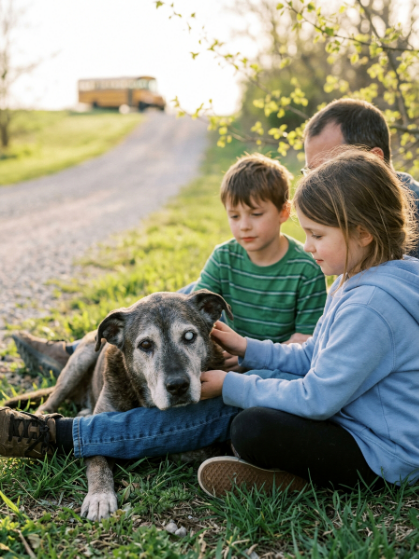
He couldn’t manage the porch steps anymore, so Greg carried him out to the grass to feel the sun. The kids sat on either side of him. And at the end of the lane, the school bus crested the hill — Lily and Sam had stayed home, but it came anyway, on schedule.
Gus lifted his gray head. Ears up. One last time, he watched the road.
Then he laid his head in Lily’s lap and let go, warm in the sun, surrounded by people who had learned, because of him, exactly how to wait with someone you love.
We buried him under the window where he kept his vigil. Sam carved a flat stone himself. It doesn’t say “good dog,” though he was. It says the thing Gus taught us without a single bark.
“He stayed.”
I used to tell my kids that we rescued Gus. I don’t say that anymore.
A thirteen-year-old dog with a broken heart taught two children that loyalty isn’t loud and it isn’t easy. It’s just showing up. Every evening at six. Watching the road for someone, long after the world tells you to give up.
We were the lucky ones. We got the old man. And the old man gave us everything he had left.