The morning after I buried my husband, there was a forty-dollar fine taped to my front door.
“Unapproved seasonal decor.” It was the black mourning ribbon I’d tied to the wreath. Diane Albright, our HOA president, had walked past my house on the day of the funeral, seen it, and reported it.
I didn’t take it down. I took a photograph of the notice instead, and I wrote the date on the back. Thirty-one years as a county title examiner teaches you one habit above all others: keep the record.
I’m Ruth Vance. To Diane, I was the quiet widow at the end of Maple Court — soft, gray, and finished. An easy line item to clean up.
The notices kept coming. My trash cans were out four minutes early. My mailbox, which had stood since 1998, was suddenly “non-conforming.” My lawn was a half-inch over the limit the week my knees wouldn’t let me stand long enough to mow. Forty dollars became three hundred. Three hundred became two thousand, with “late administrative penalties” stacked like firewood.
Then came the letter with the word that made my hands go cold.
Foreclosure.
She taped that one to my door too, at eye level, where every neighbor walking a dog could read it. That was the cruelty of it. She didn’t just want my money. She wanted the street to watch me shrink.
So I did what I’d done for three decades. I requested the association’s records — every fine, every notice, every meeting minute. By law they had to hand them over. And when I spread them across my kitchen table, I started to smile for the first time since the funeral.
Because not one of those fines was legal.
The bylaws were clear, the way Diane assumed no one would ever read. A fine required a board vote, recorded in minutes, at a meeting with a quorum. A foreclosure lien required certified notice and a hearing offered in writing. Diane had done none of it. She’d been writing penalties out of her own coral-blazer authority for two years, and the “board votes” she cited were coffee chats with her husband, Curtis, the treasurer.
It wasn’t an HOA. It was a one-woman shakedown with letterhead.
I could have hired a lawyer and ended it in private. But she’d done this in public. So I waited for the annual meeting.
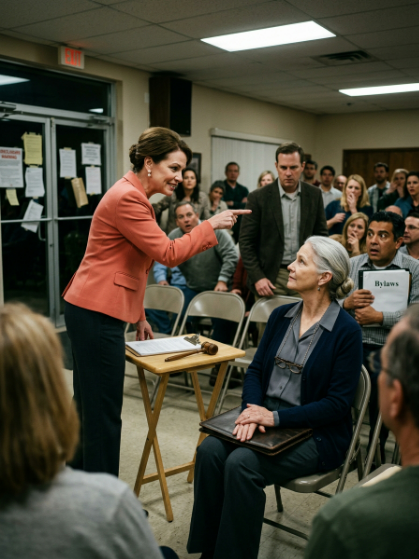
Last night the clubhouse was packed — folding chairs, fluorescent lights, the foreclosure notice still curling on the glass door behind us. Diane stood at the front with her clipboard and a little wooden gavel and decided to finish me off in front of everyone.
“Some residents,” she said, looking right at me, “think the rules don’t apply to them. They let their property rot. They don’t pay. The rest of us carry freeloaders like Ruth Vance.”
Twenty years of neighbors studied their shoes.
I let her finish. Then I stood, opened the worn leather folder on my lap, and asked one quiet question.
“Diane, can you show the room the minutes where any of my fines were approved by a quorum vote?”
She blinked. “We — the board reviews all violations.”
“That’s not what I asked. Minutes. A date. A vote. The bylaws you enforce require it. Article 7, Section 3.” I read it aloud, slowly. “Without a recorded vote, no fine is valid.”
She reached for the gavel. I kept going.
“Article 9. A foreclosure lien requires certified mail and a written hearing. I never received either. Which means the lien on my home isn’t just unfair. It’s void.”
Tomas, the new secretary, was flipping frantically through the bylaws binder, and I watched his face change as he realized I was quoting it word for word.
“So here is where we actually stand,” I said. “Every fine you levied is unenforceable. The association has been collecting illegal penalties from this entire street for two years.” A murmur ran through the chairs. People sat up. “And under Ohio law, an HOA officer who knowingly enforces invalid liens isn’t protected by the board. That liability is personal, Diane. Yours. And Curtis’s.”
Curtis went the color of paper.
I turned to the room. “I’m not asking for sympathy. I’m asking for a vote. The bylaws let you remove an officer for cause by simple majority. I’d call collecting two years of illegal fines ’cause.'”
Tomas called the vote before Diane could lift the gavel. It wasn’t close. Hands went up across the room — the same neighbors who’d stared at their shoes ten minutes earlier.
By the time it was over, Diane had been removed as president, the board had voted to refund every illegal fine to every household, and the association’s insurer had a very expensive problem with two names on it.
She left her gavel on the table.
I picked up my folder, said goodnight to my street, and drove the four hundred feet home, where my husband’s black ribbon was still tied to the wreath.
I left it up. Nobody’s fining me for it now.