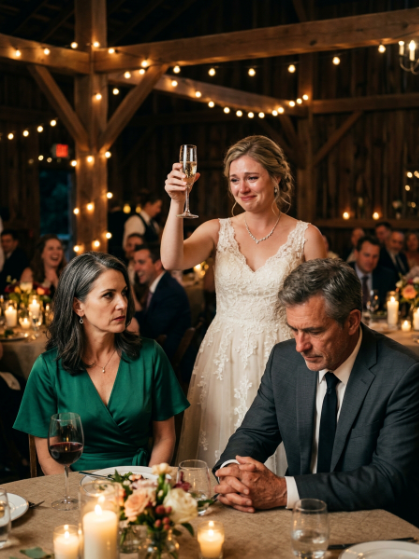
“My dad has spent fifteen years letting his own sister hate him,” Bree said into the microphone, “to protect her from something their mother begged him to carry alone. Tonight I’m breaking the promise he made, because I’ve watched what keeping it has cost him, and I think the price got too high.”
I set down the wine glass I had refused to touch all evening.
Across the table, Paul’s knuckles had gone white against the white linen.
“When Grandma got sick,” Bree said, “there was no money. There were debts nobody knew about — a second mortgage, medical bills that came faster than anyone could pay them, a loan she had co-signed for a man who took it and vanished. The house was going to be lost no matter what anyone did. Aunt Diane — your name was not left off that will because Grandma loved you any less.”
Bree’s voice cracked, and she pushed straight through it.
“It was left off because Grandma did not want you to inherit the debt that came attached to the house. She left everything to my dad because he was the only one strong enough to take the whole weight at once. The house, the loans, the lawyers, all of it. And he signed away his own half of what little was left to do it.”
The room had gone silent. Two hundred people, the band, the clink of glasses — all of it stopped.
“He sold his truck that year,” Bree said. “He refinanced his own house. He worked Saturdays for a decade. He kept Grandma’s home out of the bank’s hands and out of yours, on purpose, so that when the dust settled you would still have your savings and your good name and no creditors at your door. And he let you believe he had cheated you out of it, because Grandma made him promise, at the very end, that you would never know how bad it really got. She didn’t want you to remember her drowning in it.”
I looked at my brother.
Fifteen years. I had built an entire fortress out of a story I told myself, and he had let me live inside it, stone by stone, because our dying mother had asked him to.
“Is it true?” I said. It came out cracked down the middle.
Paul finally lifted his eyes. They were wet, and he didn’t bother to hide it.
“She made me promise in the hospice,” he said. “She held my hand and she said, ‘Don’t let Diane carry this one. Let her be angry at you instead. You’re strong enough to be hated. She’s been through enough already.’” He gave a small, broken shrug. “I wasn’t strong enough. Not really. But I tried, because she asked me to.”
I don’t remember standing up. I remember going around that long table, past Bree, and I remember my brother getting to his feet too fast and the chair tipping over behind him, and the two of us holding on to each other like the floor had turned to water.
“I missed everything,” I said into his shoulder. “Your fortieth. I didn’t come to your fortieth.”
“I know,” he said. “I missed your divorce. I sat in my truck with my phone in my hand so many nights.”
“Why didn’t you ever call?”
“Because if you had asked me the one question — why we really lost the house — I would have had to lie straight to your face. And I found out I could lose you easier than I could break my word to her.”
We talked until the band packed up their instruments around us. He showed me the file on his phone — the loan payoffs, the years of statements, the quiet ledger of a sacrifice he had never planned to show another living soul.
And there was a letter. From our mother. He had carried it for fifteen years, folded in his wallet until the creases had worn soft. It was addressed to us both, to be opened “when Paul decides Diane is ready — or when he can’t carry it by himself anymore.”
He had been waiting on a permission he was never going to give himself.
Bree gave it to him instead. In front of two hundred people, in a barn strung with warm white lights, on the happiest night of her own life, she chose to spend it healing her father.
We read our mother’s letter together at two in the morning, sitting on the hood of Paul’s car in the gravel lot. Her handwriting. Her asking me to forgive a theft that had never happened. Her telling Paul, in the very last line, to please put it down before it broke him.
It very nearly had.
Paul comes to my place for Sunday dinner now. We are fifty-two and fifty-six, two stubborn middle-aged people learning how to be a brother and a sister again from somewhere near the very beginning.
We lost fifteen years to a kindness wearing the mask of a crime.
We are not going to lose a single one of the years we have left.