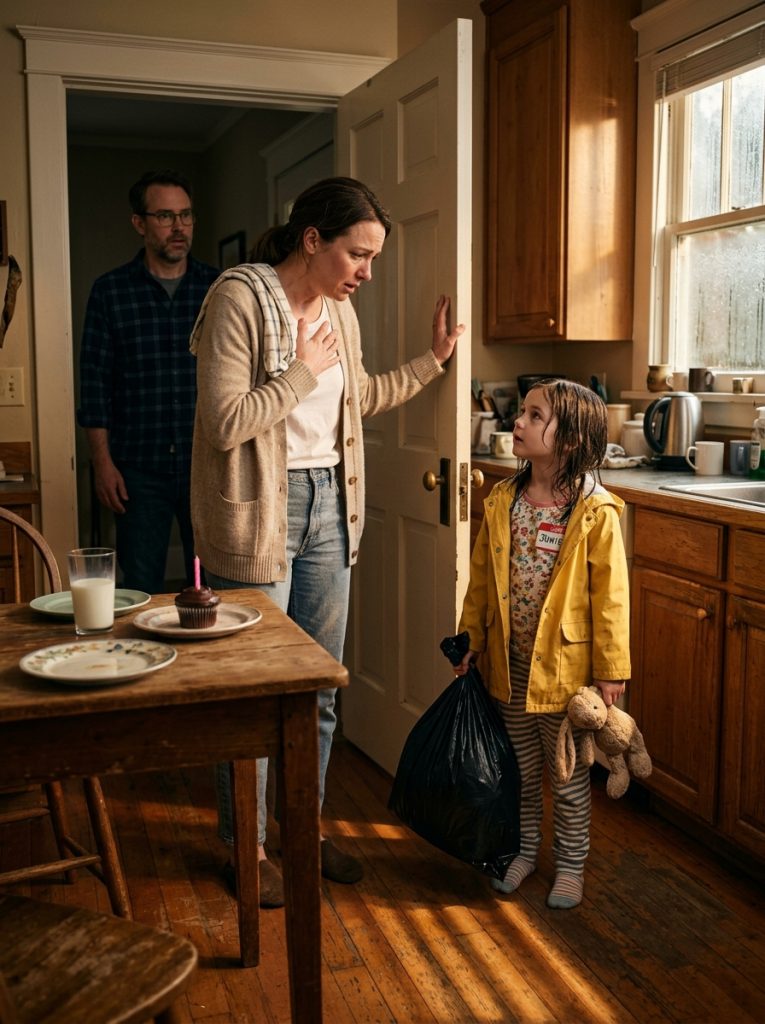
The little girl in my kitchen set down a trash bag full of everything she owned, looked up at me, and asked the same question she asked every family.
“Is this forever?”
She was seven. She’d already learned to ask it at the door, before she took off her shoes, before she let herself want anything.
I didn’t answer right away. I’ve thought about that silence every day since.
My name is Tessa Hartwell, and Junie was our third placement in two years.
The caseworker, Ms. Okafor, walked her into our craftsman house in Southeast Portland on a rainy Tuesday with that black trash bag and a one-eared stuffed rabbit and a name-tag sticker still stuck to her chest, like she was a parcel being delivered.
“This is the Hartwells,” Ms. Okafor said gently. “You’ll be staying here a while, sweetheart.”
And Junie looked up at me with those careful, grown-up eyes and asked it.
“Is this forever?”
Three homes, her file said. Three families who’d said “we’ll see,” and then, months later, “it’s not working out.” She’d stopped crying when she got moved. The crying kids are the ones who still believe. Junie just packed her bag and waited by the door.
Here’s the part I never told the agency.
Two years before Junie, my husband Daniel and I had almost adopted a little boy named Sam. We’d painted the nursery a soft green. We had the court date circled on the calendar. And nine days before it was final, his biological grandmother surfaced, healthy and willing, and the court returned him to her. Legally. Completely. We never saw him again.
I grieved him like a death. And somewhere in that grief I made a vow: I would never say the word “forever” to a child again. Because I’d learned, in the cruelest way, that I couldn’t promise it.
So when Junie asked me, standing in her too-small yellow raincoat, I froze.
“Let’s get you some dinner,” is what I finally said.
I watched her face do this small, practiced thing — a little nod, like she was filing me under “the same as the others.” That nod broke something open in me.
The weeks that followed were quiet. Junie was easy in the way that scared me most: she never asked for anything. She made her own bed with hospital corners. She apologized when she sneezed. When I bought her a pack of hair ribbons, she didn’t open them — she set them aside “in case we have to give them back.”
One night I found her sorting her belongings into two piles on her bed. “What are you doing, sweet pea?” I asked.
“Stuff that fits in the bag,” she said, “and stuff that doesn’t. So I’m ready.”
Ready to leave. Always ready to leave.
That night I couldn’t sleep. Daniel found me at the kitchen table at two in the morning with the foster-to-adopt paperwork and a pen.
“What are you doing?” he whispered.
“The thing I swore I’d never risk again,” I said. My hand was shaking. “Daniel, she’s planning her own goodbye. She’s seven. I can’t let her keep living out of a trash bag.”
He sat down. He took my hand. “Then we stop telling her ‘we’ll see,'” he said. “And we tell her the truth.”
We filed the petition the next week.
It wasn’t simple. There were home studies and hearings and a termination of parental rights that had already been finalized months before — Junie’s birth parents were long out of the picture, which somehow made it sadder, not easier. There were nights I lay awake terrified that some grandmother would appear, the way Sam’s had, and take her back.
But no one came. Junie was free to be loved, and had been for a long time. She’d just never been chosen.
Six weeks later we stood in front of a judge at the Multnomah County courthouse, and Junie wore a dress she picked herself — yellow, of course — and swung her feet because they didn’t reach the floor.
The judge, a kind man with reading glasses pushed down his nose, looked over his desk at her.
“Junie,” he said, “do you understand what’s happening today?”
She glanced at me. Then back at him. And she asked the only question she’d ever really cared about.
“Is this forever?”
The whole room went still. Ms. Okafor, in the back, pressed a hand to her mouth. Daniel gripped my fingers so hard it hurt.
The judge took off his glasses. “Yes,” he said. “That’s exactly what this word means.” He held up the order. “After today, you’ll have a new last name — the same one as your mom and dad. Hartwell. And nobody can ever ask you to pack a bag again. This home is yours. Forever is what we’re here to make official.”
Junie turned and looked at me with an expression I had never once seen on her face.
She let herself believe it.
She climbed down off the chair, walked over, and pressed a name-tag sticker against my sweater — she’d written it herself in the waiting room, crooked purple letters: MOM.
I’m not going to pretend the lost years didn’t happen. Three homes left a mark. There are still nights she startles awake convinced she’s being moved. There are still moments she says “if I get to stay” instead of “when.” Healing the word “forever” into a child takes longer than a court date.
But last week, for the first time, I caught her unpacking the hair ribbons. Using them. Leaving the empty package in the trash without a flicker of worry.
She’s a Hartwell now. She has a bed with her name over it and a drawer that’s hers and a mother who finally learned that the only thing worse than risking your heart is teaching a child she isn’t worth the risk.
If every kid deserves to hear the right answer to that question — and they do — comment “FOREVER.” 🤍