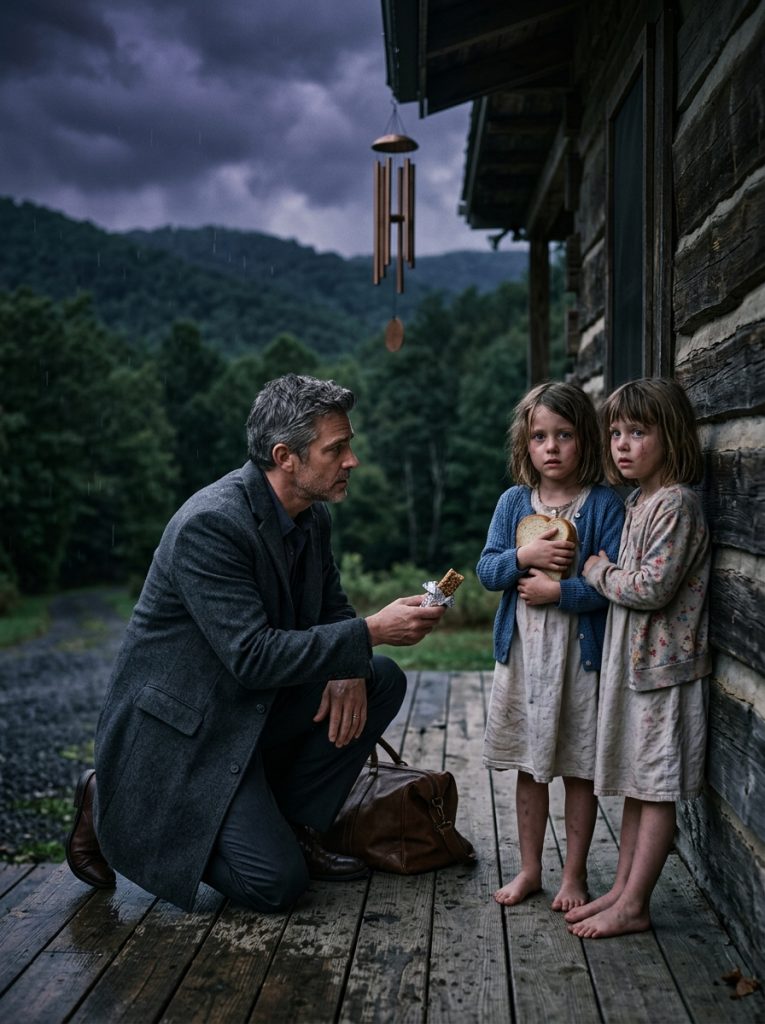
The storm was twenty minutes out and the only road down the mountain was already starting to wash. I’d come to sell a house, not to be trapped in one.
My name is Daniel Hargrove. I’m 44. I close deals in glass towers in New York, and I hadn’t set foot on this mountain in three years — not since we scattered my wife’s ashes off the ridge. Olivia loved this drafty, impossible cottage in the Blue Ridge. I never understood it. After the cancer took her too fast, I locked the door and let the lawyers handle the rest. Today I finally drove up to clear it out and list it.
I came around the side of the porch in my city overcoat and dress shoes, the first fat raindrops smacking the gravel, and stopped cold.
Two little girls were sitting on the steps. Maybe six. Identical twins. Barefoot, in thin cardigans over nightgowns, in fifty-degree mountain wind. Hair cut crooked, like someone did it with kitchen scissors. One gnawed a hard heel of old bread.
When they saw me, they went rigid, pressed back against the cottage wall.
“Hey,” I said, soft as I could. “It’s okay. Are your parents here?” Nothing. Four wide eyes on my hands. I crouched, slow, and held out the granola bar from my coat pocket on an open palm. Both girls flinched like I’d raised a fist. That flinch — I’ll never unsee it. “I’m not going to hurt you,” I whispered, and my voice cracked, a man who negotiates nine-figure deals undone by two barefoot kids. “Are you hungry?”
The smaller one stared at the bar. Then at me. Then she looked right at me and said the only words either of them would speak: “She said you’d come.”
The bottom dropped out of my stomach. Because she was gone. Three years gone.
A voice came up the path then — an older woman in a rain slicker, hurrying, calling, “Ella! Emma! Don’t run off like—” She stopped when she saw me, and her whole face changed. “Oh,” she breathed. “Oh, thank God. You came. You really came. Olivia said you would, and I’d half stopped believing it.”
Her name was Ruth. She’d been Olivia’s friend up here for twenty years, and over the next hour, in the cottage kitchen while the storm hammered the tin roof and the girls finally ate, she told me about the wife I thought I knew.
Olivia had a younger half-sister. Maggie. I never knew she existed — Olivia kept her hidden, out of a protectiveness I didn’t understand until that night. Maggie had struggled her whole life, with addiction, with a kind of pain that never let her go. For years Olivia had quietly kept her afloat — money, rehab, rent — and never told me, because she thought my world of deals and glass towers had no room for a sister like Maggie, and maybe she was a little ashamed, and maybe she was protecting all of us at once.
The girls were Maggie’s. Ella and Emma.
And this cottage — the one I never understood why Olivia loved, why she kept it when we could’ve sold it for a fortune — was the safe house. It was where she’d told Maggie to go if everything fell apart. “If I’m not here,” Olivia had told her, “take the girls to the cottage and wait. Daniel has a good heart, even when he doesn’t know he’s using it. He’ll come, and he’ll do right by them.”
Maggie died three weeks ago. Ruth had been keeping the girls, trying to reach me through the lawyers, when she heard the cottage was finally being listed — that the owner was coming up at last. So she brought them today. To wait on the porch. The way Olivia said.
“There’s a letter,” Ruth said. “Olivia left it here years ago. Told me where. Said if you ever came back, you were ready to read it.”
It was in the kitchen drawer under the copper wind chime’s spare hook, in Olivia’s handwriting, the sight of which undid me before I read a word. I won’t share all of it. But the end:
“I know you, Daniel. You think you’re only good at closing deals. You’re the kindest man I ever met — you just never learned how to be needed, so you fill the empty space with work. If you’re reading this, then I’m gone and Maggie couldn’t hold on, and two little girls are somewhere in this house who have no one. I couldn’t ask you while I was alive; I was afraid you’d say it wasn’t your problem and prove me wrong about you. So I’m asking now, when I can’t see your face. Don’t let them be no one’s. Be theirs. You’ll be so much better at it than you think. — O.”
I sat at that table and cried for my wife in a way I hadn’t managed in three years — because I’d just met the best part of her, the part she carried alone, and it was too late to tell her I was proud, too late to thank her, too late to say I’d have made room. That’s the grief I’ll keep. She loved me enough to believe I’d rise to something I never knew was coming, and she didn’t get to watch me do it.
I didn’t list the cottage.
I knelt down in front of two wary girls with crooked haircuts, and this time when I held out my hand I didn’t offer food. I just held it there, open, and waited.
It took a long time. Storms do pass, though. Eventually the braver one, Ella, put her small cold hand in mine.
“She was right,” I told them, though they couldn’t understand yet. “She’s always right.”
The lawyers are different lawyers now — family ones. It’s slow, and I’m clumsy at it, and I’ve learned more about braiding hair from internet videos than I ever thought a man could. But the cottage has heat now, and shoes that fit, and three places at the table.
I hung the copper wind chime back on its hook the first clear evening. The girls watched it turn.
Olivia hung that chime so she could hear the wind coming for the people she loved.
Now I listen for it too.